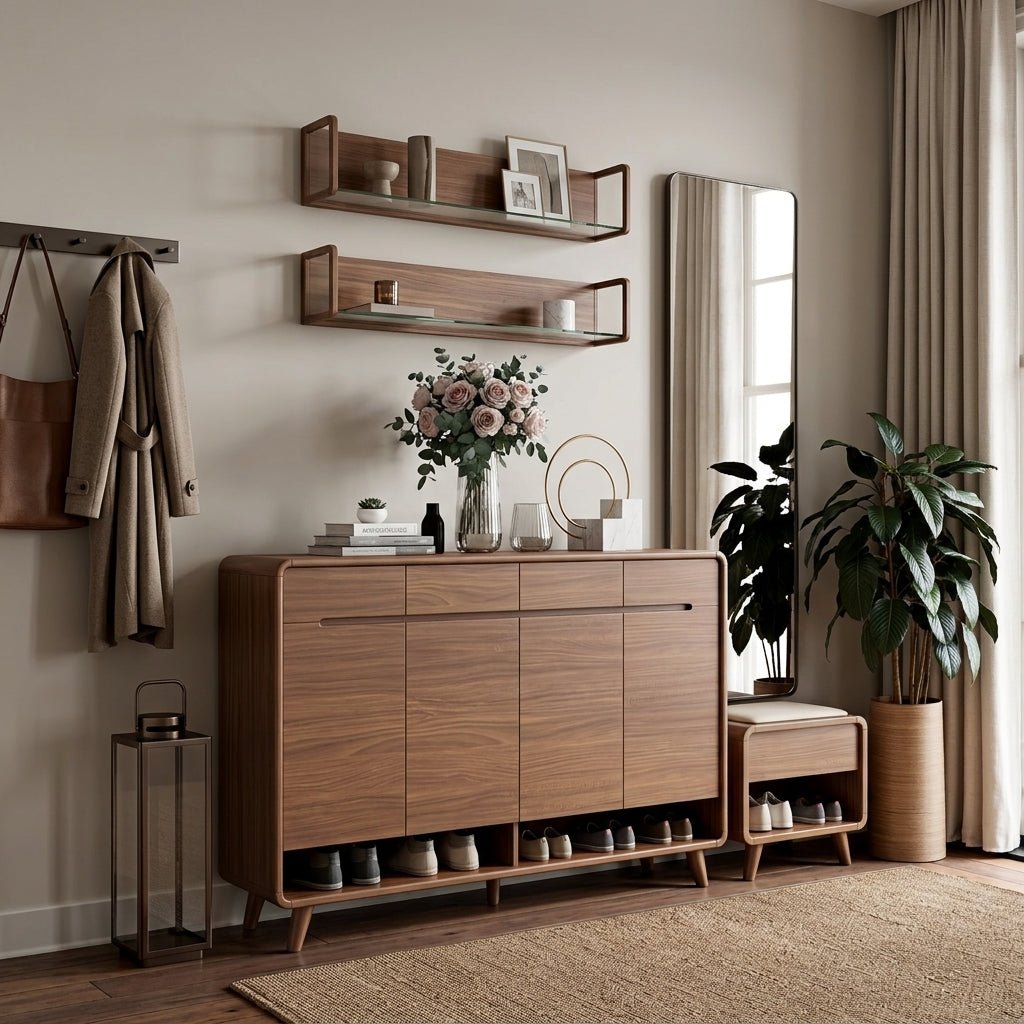
Design Trends / 2026
The 8 Canadian Home Design Trends Defining 2026
Curves, earth tones, and a growing preference for furniture built to last decades, not seasons.

Walk into a thoughtfully designed home in Toronto, Montreal, or Vancouver right now, and something registers before you can name it. The spaces feel more settled. Less performed. There are fewer things, but the things that remain are chosen with care you can see from across the room. The palette pulls from fog and birch bark rather than whatever was popular eighteen months ago.
This is the shape of Canadian interiors in 2026. After years of reactive buying and trend-chasing disrupted further by supply chain chaos, homeowners across the country are recalibrating toward quality, warmth, and restraint. The eight trends we cover here are not about novelty. They are about decisions: which furniture earns its place, which materials age with character, and which rooms deserve the investment they have been waiting for.
We reviewed what came out of DesignTO and Maison&Objet, studied the work of Canadian designers from coast to coast, and visited showrooms. What follows is an honest account of where Canadian home design is headed, and how to bring these ideas into your own space.
Warm Minimalism: The Case for Fewer, Better Things
Minimalism spent the better part of a decade becoming something it was never meant to be: cold. The all-white interiors, the bare concrete, the furniture that looked better in a photograph than a lived-in room: these are what gave restraint a bad name. In 2026, Canadian designers are recovering the actual point of minimalism, which is that edited spaces feel more peaceful, not more austere.
The difference is in the materials. Cold minimalism reached for surfaces that repelled warmth: polished concrete, high-gloss lacquer, chrome. Warm minimalism reaches for the opposite: natural linen, solid oak, matte stone, undyed wool. The rooms are still disciplined. The furniture count is still low. But the tactile quality of every remaining piece justifies its presence by doing something a photograph cannot capture: it rewards being in the room.

Albi Curved Fabric Sofa / $3,180 / Altera

Adana Sideboard / $3,499 / Altera
For Canadian homeowners, the shift begins with the sofa. The Aarhus Cloud Sofa ($3,590) and the Albi Curved Fabric Sofa ($3,180) both illustrate the principle: generous proportions, natural fabric, solid oak frames, and a profile that settles into a room rather than demanding attention. Neither reads as statement furniture. Both transform the rooms they sit in.
Storage is where the philosophy extends. The Adana Sideboard ($3,499) earns its wall in a living room or dining space: dark walnut veneer, corduroy wood detailing on the cupboard fronts, a clean metal base. At 221cm, it is substantial enough to anchor a room without overwhelming it. The craftsmanship holds up at close range, which is precisely what warm minimalism requires of every piece.
Earth Tones: Canada's Colours Are Finally Coming Indoors
The all-white interior had a long run. It photographed beautifully, aged badly, and made every room in the country feel like it belonged to the same anonymous landlord. In 2026, colour is returning to Canadian homes. Not as an experiment. The palette drawing the most serious attention pulls directly from the Canadian landscape: terracotta, warm clay, dusty olive, muted ochre, the red-brown of cedar heartwood.
These are not colours imported from European trend reports. They are the colours you see from a car window in October driving through the Gatineau Hills, or from a hiking trail in Kootenay at dusk. Designers who have spent years chasing imported aesthetics are finding that the most resonant palette was always outside the window.

Terracotta King Bed / $2,790 / Altera

Fort-de-France Bed with Nightstands / From $2,599 / Altera
Earth tones work indoors for a reason that colour theory does not fully capture: they respond to light dynamically. A wall in warm clay at noon and at five in the afternoon are two different walls. The colour shifts as the light shifts, which means the room is never static. White walls cannot do this: they go flat the moment the sun angles away. Terracotta and ochre grow richer as the light drops.
The bedroom is where this trend is making the deepest impression. The Terracotta King Bed ($2,790) offers an ultra-low platform profile in premium stain-resistant linen-blend, its colouring warm enough to anchor a room without demanding coordination. For a more architectural approach, the Fort-de-France King Bed with matching nightstands (from $2,599) brings hand-tailored performance velvet, a reinforced hardwood frame, and the kind of low-profile presence that makes a bedroom feel finished rather than furnished.
Trend 03Curvilinear Furniture: Rounds and Arcs Are Solving Real Design Problems
The angular furniture revival peaked and is now receding. In its place: curves. Not as a style statement, but as a practical response to how we actually use rooms. A round dining table solves the problem of the corner seat that nobody wants. A curved sofa arm does not catch elbows as you pass. A dining chair with gently bowed back rails feels different after two hours at the table.
Canadian designers are not chasing the exaggerated organic forms seen in some American and European interiors. The local interpretation is quieter: gentle radii, rounded corners, profiles that soften a room without demanding that the room be organized around them. A single curved piece in a pared-back space carries significant visual weight. That weight comes not from volume but from contrast. The eye distinguishes one curve against many straight lines far more readily than it distinguishes one rectangle among others.

Olympus Round Dining Table / $2,960 / Altera Home Design
The Olympus Round Dining Table ($2,960) illustrates what curvilinear design looks like when it is taken seriously. A solid slab of Sahara Noir marble, polished to a high gloss, rests on a sculptural cone-shaped steel pedestal with brushed bronze finishing. The 135cm diameter accommodates six comfortably. There is no bad seat.

Aero Curve Walnut & Leather Dining Set / $2,590 / Altera

Kelowna Rounded Solid Wood Table / $3,490 / Altera
At a warmer price point, the Aero Curve Walnut and Leather Dining Set ($2,590) pairs a solid walnut tabletop on a brushed stainless steel base with six top-grain leather chairs in walnut veneer, a complete dining room in one decision. For those who want something more Scandinavian in character, the Kelowna Rounded Solid Wood Table ($3,490) offers smooth rounded edges and a natural veneer finish on substantial cylindrical legs. Three sizes available.
Designer's Tip
Mixing Curves and Straight Lines
An entirely curved room loses definition. The principle is contrast: one or two curved hero pieces (a dining table, a sofa, an armchair) against the clean horizontal line of a media console or the vertical grid of open shelving. The tension between the two gives a room visual rhythm. Without the straight lines, the curves read as decor. Without the curves, the room reads as rigid.
Textured Rugs: The Foundation, Not the Finish
For decades, the rug came last. You furnished the room, placed the furniture, and found something to fill the gap on the floor. In 2026, that sequence is reversing. Designers are treating the rug as the first decision: the piece that determines the room's material language, its colour temperature, and the proportions of everything placed on top of it.
The rugs leading this shift are defined not by pattern but by fibre, texture, and surface quality. Bamboo silk with its subtle luminosity. New Zealand wool with its natural irregularity. Hand-woven Tencel with a softness that reads as luxury without signalling it loudly. These are materials that change in different light, that reveal the weave when you look closely, that feel distinctly different underfoot on a January morning. They justify the investment not through appearance alone but through daily experience.

Earth-Tone Bamboo Silk Rug / From $1,590

Japandi Handcrafted Round Rug / From $1,890

Urban Ink Distressed Woven Carpet / From $490
The Earth-Tone Abstract Bamboo Silk Rug (from $1,590) demonstrates what happens when you choose the rug first: its warm geometry sets a tone that guides every subsequent choice. The Japandi Handcrafted Round Rug (from $1,890) in hand-woven Tencel is for spaces that want softness without colour. The Urban Ink Distressed Woven Carpet (from $490) offers graphic depth in monochrome diatom silk for rooms that need contrast.
Circular rugs are having a particularly strong year. Placed beneath a round dining table, they create a visual island that unifies the seating without walls. In a living room, they draw furniture into a natural grouping. In open-concept spaces (which describes most Canadian homes), they do the work of walls, delineating one zone from another without closing anything off.
The Bedroom as Sanctuary: Investing Where It Matters Most
Canadians have traditionally put their money into the rooms guests see: the kitchen, the living room, the dining space. The bedroom, which most people spend a third of their lives in, often received the budget that remained after everything else was done. That calculus is changing. The bedroom is getting serious attention: not as a showroom space but as a place designed explicitly for rest, quality of sleep, and the quiet hour before the day begins.
The shift shows up most clearly in bed frames. Upholstered headboards with generous padding, kiln-dried hardwood frames, high-resilience foam: these are the criteria of someone buying for the long term rather than the current season. The bed is the room's gravitational centre. When it is right, the rest of the decisions become easier.

Linden Modern Upholstered King Bed / From $2,790 / Altera Home Design
The Linden Modern Upholstered King Bed (from $2,790) earns its place in any serious bedroom conversation: kiln-dried hardwood frame, walnut accents, an elegantly curved padded headboard, premium woven fabric that holds its form. The silhouette is clean enough to work in a room of any proportion. For those who want wood rather than fabric, the Alfred Round Off Bedroom Set (from $2,549) brings softened corners, natural veneer in light oak or walnut, and the option to add matching nightstands and a six-drawer dresser in one purchase.

Alfred Round Off Bedroom Set / From $2,549 / Altera Home Design
Bedroom palettes are trending warmer and darker than the rest of the home. Dusty olive and warm charcoal are appearing in rooms that would have been cream or white two years ago. The intention is to create a room that reads as a threshold, a space with a noticeably different register from the daytime areas. You cross into it, and something shifts. That is not an accident of decoration. It is a deliberate design decision.
Designer's Tip
The Sixty-Second Reset
Design your bedroom so that it takes less than sixty seconds to transition from work mode to sleep mode. That might mean a dedicated tray for your phone and reading glasses that signals the end of the screen day, a bedside lamp on a dimmer rather than an overhead switch, or a wardrobe with doors that closes the visual noise of the closet away. The boundary matters as much as the furniture.
Japandi Grows Up: Wabi-Sabi as a Standard, Not a Style
The first wave of the Japandi trend produced a lot of interiors that looked Japanese without understanding what made Japanese design worth understanding, and Scandinavian without understanding hygge beyond its candle imagery. Rooms that were visually correct but felt like sets. In 2026, something more genuinely interesting is happening: Canadian designers are moving past the aesthetic coordinates of Japandi into its underlying philosophy, which is wabi-sabi, which is the acceptance of imperfection and transience as things to be embraced rather than corrected.
In practice, this means choosing furniture and objects that will reveal rather than conceal the passage of time. Solid wood that darkens and gains depth with sunlight. Top-grain leather that develops a patina rather than wearing out. Hand-woven textiles with the natural irregularity that machine production cannot replicate. The question is not "does this look Japanese?" The question is: "will I find this more beautiful in ten years than I do today?"

Kensington Leather Chair & Ottoman / $1,990 / Altera

Mori Sculptural Chair / $749 / Altera
The Kensington Leather Lounge Chair and Ottoman ($1,990) is the kind of piece wabi-sabi describes. Top-grain aniline leather, solid hardwood frame, sinuous spring suspension, ash wood legs with an ebony finish. Nothing about it will look worse after a decade. The leather will soften and shift. The wood will deepen. This is what investing in wabi-sabi actually means: not buying things that look aged, but buying things that age.
The Mori Sculptural Chair ($749) offers the same philosophy at a different scale: a saddle seat carved from solid ash with traditional mortise-and-tenon joinery, finished in non-toxic matte lacquer. It works at a kitchen island, a studio, or beside a desk. Its form is the result of a craft decision, not a styling one. That is precisely the distinction that defines the best Japanese-influenced design.
Trend 07The Home Office That Belongs: Design for How You Actually Work
The improvised home office (laptop on the dining table, monitor on a box, chair borrowed from the kitchen) was always a temporary arrangement. What took longer to fix was the next iteration: the proper desk in the guest room that still looks like it was transplanted from a corporate environment. In 2026, Canadian homeowners who work from home are solving the real problem: designing a workspace that is part of the home, not a satellite of the office.
This means choosing a desk with the same material seriousness applied to the dining table or the living room credenza. It means storage that closes at the end of the working day, returning the room to its home register. And it means lighting that addresses the particular challenge of the Canadian winter: months of diminished natural light that make task lighting not a luxury but a daily necessity.

Artisan Walnut and Marble Office Desk / $4,250 / Altera Home Design
The Artisan Walnut and Marble Office Desk ($4,250) is the definitive expression of this principle. Solid walnut with a natural Golden Silk marble inlay, asymmetrical form, stainless steel legs, scratch-resistant lacquer. At 220cm by 95cm, it is substantial enough to hold a complete workstation without the surface feeling crowded. It reads as a piece of furniture, not office equipment. That is exactly the psychological distinction a home office requires.

Vantage Executive Desk / $2,690 / Altera

Antwerp Modern Floor Lamp / $450 / Altera
At a step down in investment, the Vantage Executive Desk with Three-Drawer Pedestal ($2,690) offers a high-gloss lacquer finish over a metallic paint base, a stainless steel frame, and integrated storage in two sizes. For lighting, the Antwerp Modern Floor Lamp ($450) addresses the winter light problem directly: 158cm of architectural carbon steel, frosted opaline glass shade, step-less dimmer, 360-degree pivot. It provides warm, focused ambient light without the flat overhead quality that makes working from home feel like working from a conference room.
Designer's Tip
Designing for the End of the Day
A home office that cannot visually close at five o'clock is one that will colonize your evenings. The solution is not a door. It is a surface discipline. Choose a desk whose top can be cleared in thirty seconds and a storage piece that holds everything behind closed fronts. When the laptop lid closes, the room should read as something other than a workspace. That switch is not cosmetic. It is the whole point.
Forever Furniture: The Economics of Buying Right Once
The most consequential shift in Canadian design culture this year is not about aesthetics. It is about purchasing logic. A growing number of homeowners are abandoning the cycle of budget furniture replaced every three to five years and replacing it with a different calculation: fewer pieces, chosen with greater care, built to last for decades.
The numbers behind this are straightforward. A sofa that costs $3,000 and lasts fifteen years costs $200 per year of ownership. A sofa that costs $900 and requires replacement after four years costs $225 per year and ends up in a landfill. The forever piece is the rational choice, not the luxury one. The luxury is in the experience of owning something well-made, which is a different category of value from the price alone.
The forever piece philosophy asks a different set of questions before any purchase:
- Is this built from materials that improve or at least hold their character with age?
- Does the silhouette work in a variety of rooms, or is it tied to a specific layout?
- Can the upholstery or surface be refreshed without replacing the frame?
- Would I still want this in the home I expect to have in ten years?
Built for decades, not seasons. The Kelowna Rounded Solid Wood Table ($3,490) / Altera Home Design
Furniture built with kiln-dried hardwood frames, high-resilience foam, and solid wood or quality veneer construction is not immune to Canadian conditions: it is designed for them. Our climate subjects furniture to humidity and temperature swings that accelerate the deterioration of particleboard, poly-fill, and poorly seasoned wood. Investing in construction quality is, in the Canadian context, also investing in durability.
The Kelowna Rounded Solid Wood Table ($3,490) is a reasonable example of what forever furniture looks like in practice: a natural veneer over multi-layered solid wood core, substantial cylindrical legs, smooth rounded edges, clean Scandinavian silhouette. It will work in the apartment you have now and the house you buy later. It will look as considered in fifteen years as it does today. The patina it develops is not aging. It is character.
How to Apply These 2026 Trends to Your Home
What connects these eight trends is a single word: intention. The Canadian home in 2026 is not defined by any particular colour or style or silhouette. It is defined by the seriousness with which its inhabitants approach each decision. Which piece earns this room? Which material will serve us for ten years? Which space has been improvised long enough to deserve real investment?
This is a maturation of taste, not a change in trend. For a long time, Canadian interiors drew from elsewhere: Scandinavian minimalism, Mediterranean warmth, American maximalism, whatever was visible on the platforms of the moment. What we are seeing now is something different: a design sensibility that reflects Canadian light, Canadian landscape, and Canadian climate rather than borrowing from climates we do not have.
Start with one room. Choose its single most important piece (the bed, the sofa, the dining table) and approach that decision as a forever purchase rather than a placeholder. Let that piece set the material language. Let everything else follow. The Canadian home that feels most distinctly and confidently itself is not the one that followed every trend on this list. It is the one that chose three things with extraordinary care and let the rest breathe.
Find Your Forever Pieces
Explore Altera's collection of modern furniture and designer rugs, chosen for the Canadian home.
Shop the Collection