Buying Guide / 2026
How to Furnish a Living Room: The Complete Canadian Buying Guide
The right sofa, the right rug, and why the sequence you buy them in matters as much as the pieces themselves.
Walk into a living room that works, and you understand it before you can describe it. The furniture is the right scale for the room. Nothing fights for attention. The sofa and the rug and the table hold together as though someone thought them through before buying any of them. It feels, simply, finished.
Most living rooms are not like this. Most are the accumulated result of separate decisions made at different times, from different references, under different constraints. The sofa that was the right size for the old apartment. The coffee table bought on impulse at a sale. The rug that was what was available in that colour at that price. Each individual decision was defensible. Together, they produce a room that functions but never settles.
The gap between those two rooms is not budget. It is sequence. Furnishing a living room well requires treating it as a single decision rather than a series of them: each piece chosen in relation to what comes before and what comes after. This guide gives you that sequence, the reasoning behind it, and the specific products in Altera's current collection that best serve each step. Prices are in Canadian dollars, with free shipping across Canada included on every piece.
Three Mistakes That Kill a Living Room Before It Starts
These are not aesthetic mistakes. They are structural, and they cannot be corrected by adding accessories or repainting walls. Understanding them takes five minutes and saves years of living with a room that almost works.
Buying to the Wrong Scale
A sofa that fits the room in theory does not always work in practice. The common version of this mistake: buying a 250cm sofa because the wall is 300cm wide, without measuring the depth of the room. A sofa that is 96cm deep leaves you 90cm of clearance to the coffee table and another 90cm from there to the television wall. In a room that is 380cm deep, that math works. In a room that is 340cm deep, you are squeezed. Measure the footprint, not just the wall.
The second version: buying a sectional in a room where a sofa would serve better. A sectional is correct when you have a room large enough to define a living zone around it, typically above 14 by 15 feet (425 by 455cm). Below that, a well-proportioned three-seater and an accent chair give you equivalent seating in far less floor space, with the added benefit of visual lightness.
Mixing the Wrong Material Temperatures
Every material has a temperature: warm or cool, light or heavy. Solid walnut and warm linen read warm. Chrome and concrete read cool. Bleached oak and cream linen sit in the neutral middle. A living room does not need to be entirely one temperature, but it cannot be half and half without looking unresolved. Two pieces that are each beautiful independently can produce a room that looks cluttered if they sit at opposite ends of the material temperature axis.
The practical test: before buying a second major piece, hold it mentally against the first. Are both warm-toned, or is one warm and one cool? A cedar green velvet sofa and a white lacquer coffee table can work together, but only if you understand the contrast you are creating and build the room around it deliberately. Contrasts that are designed read as choices. Contrasts that happen accidentally read as mistakes.
Buying Everything at Once
The most expensive version of the living room mistake is buying every piece at the same time from a single reference, typically a showroom floor arrangement or a single online session. Showroom arrangements are designed to sell the room, not to translate to your room. They use standardized spaces, professional lighting, and a full complement of accessories that no real home deploys. The sofa looks perfect in the showroom. At home, in your specific room with your specific light, it is slightly too dark or slightly too large and there is no going back.
The alternative: buy the sofa first. Live with it for two weeks. Then buy the rug. Then the coffee table. Each decision informs the next, and each piece you live with gives you information about what should come next that no amount of planning can replicate.
The Sofa: Everything Else Is Sized Against It
The sofa is the first purchase because it is the largest, and because it sets the scale for every subsequent decision. The coffee table is sized to the sofa. The rug is sized to the sofa and coffee table together. The accent chairs are chosen to complement the sofa, not the other way around. Buy the sofa last and you are fitting everything else to a room that already has an anchor; the choices get harder and the outcomes are less coherent.
How to Size It
The standard three-seat sofa in the Canadian market runs between 200 and 240cm wide. For a room that is 12 to 14 feet wide (365 to 425cm), a sofa between 200 and 225cm is the right range. For a room that is 14 to 16 feet wide (425 to 490cm), 225 to 240cm is appropriate. For a room wider than that, or for an open-plan layout where the living zone needs a piece large enough to define it, consider a sectional.
Depth matters as much as width. A sofa that is 94cm deep requires 18 to 24 inches (46 to 61cm) of clearance to the coffee table. Factor in the coffee table depth, and you need at least 280 to 300cm of room depth from the sofa back to the opposite wall to avoid a cramped path through the space. If you have less, choose a sofa with a shallower profile, typically 85 to 90cm.
What the Frame Tells You
Most sofa listings describe upholstery in detail and frame construction in the vaguest possible terms. "Solid hardwood frame" is used for everything from kiln-dried beech to finger-jointed pine. The difference matters: beech and plywood with S-spring or webbing suspension is the construction that holds its shape over a decade of daily use. Pine and MDF is appropriate at lower price points but will sag noticeably within three to five years under regular load.
In the $3,000 to $6,000 range, you should be getting solid beech or meranti frame construction with webbing or S-spring suspension and high-density foam cushioning at minimum. Below $2,500, honest about-the-price-point construction is reasonable. Above $3,000, a vague frame description is a warning sign.
Folkestone Sofa

Folkestone Sofa / Altera Home Design
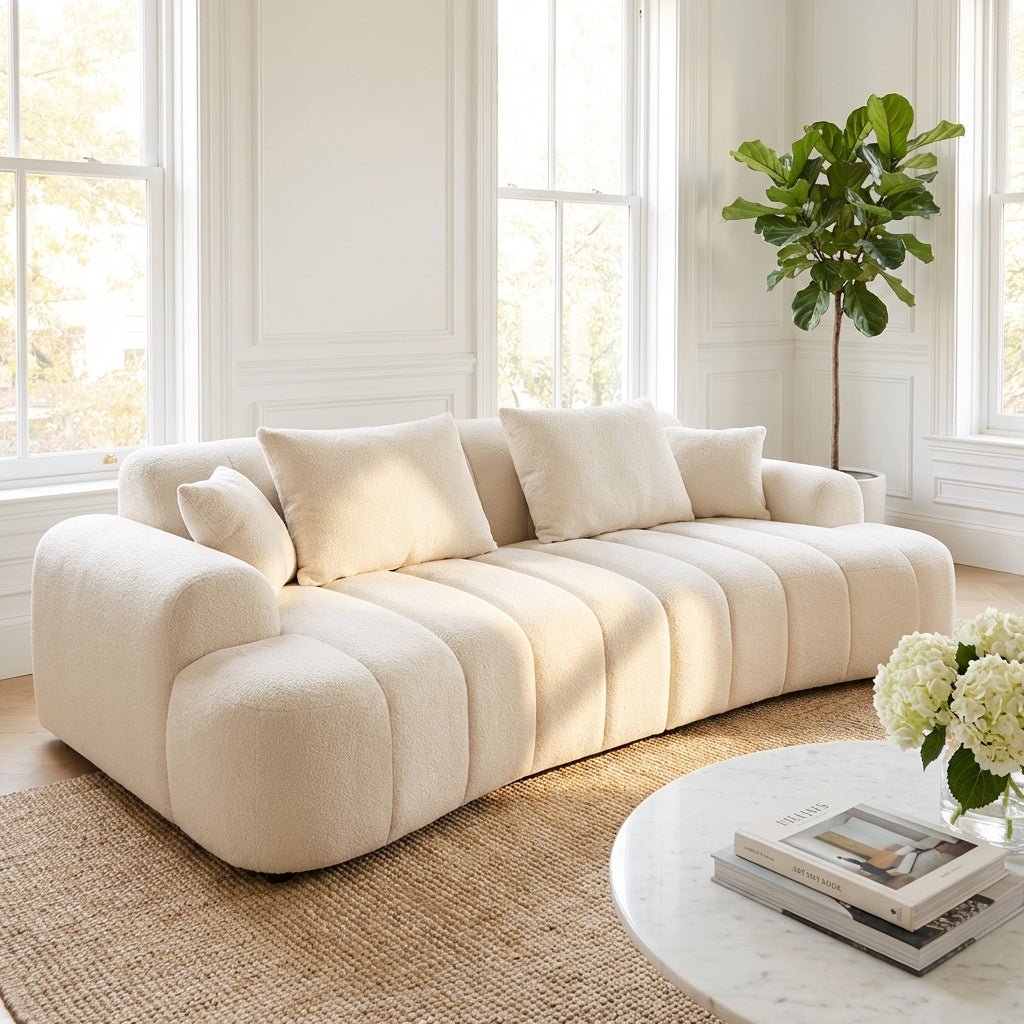
The Folkestone is the clearest recommendation for a standard Canadian living room, and the reason is construction: the solid beech and plywood frame with S-frame and webbing suspension is the right structural foundation at this price. The boucle upholstery carries a 100,000 rub count, which means it will not pill or wear thin under a decade of daily use. Foam and fibre fill both the seat cushions and the back cushions. The combination of correct frame construction and performance upholstery at $3,549 CAD is not common in this market.
At 234cm wide by 89cm deep, the Folkestone works in rooms from 14 feet wide upward. The 89cm depth is deliberate: it seats people of different heights comfortably without the oversized, swallow-you-whole depth that makes some contemporary sofas difficult to sit on properly. The boucle in its current colourway sits at the warm-neutral end of the palette, which makes it easier to build around than a more specific tone. For the buyer who wants the most structurally sound, long-lasting sofa at a genuine mid-range price, the Folkestone is the answer.
$3,549 CAD / regular $4,749
Boucle, 100,000 rub count · Solid beech and plywood, S-frame and webbing · Foam and fibre cushions · 234 × 89cm · Free shipping
Farnborough Sectional
Farnborough Sectional / Altera Home Design
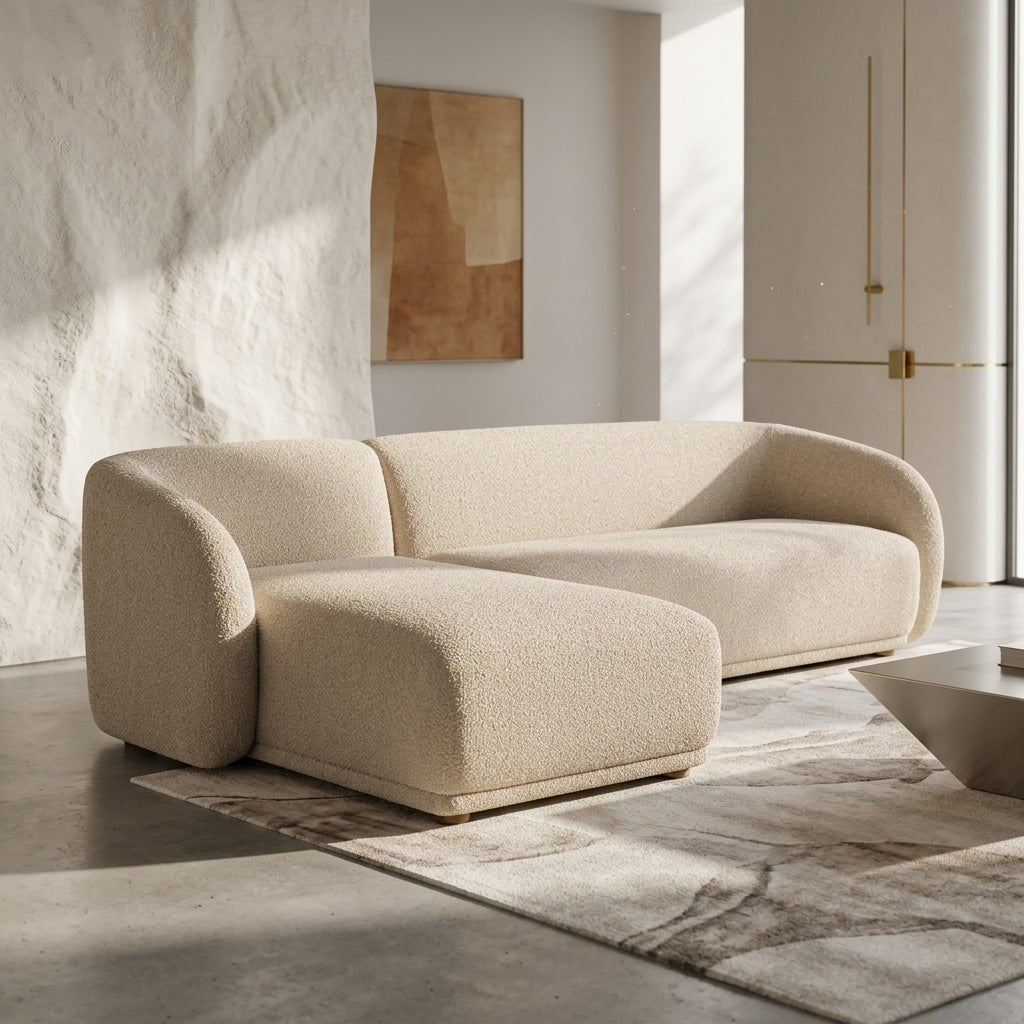
The Farnborough is for buyers who have the room for a sectional and want the sectional to do more than just seat people. The rounded back profile, which curves inward at the corners rather than meeting at a right angle, creates a different kind of seating arrangement: more gathered, more enclosed, better suited to a room where you want the conversation to stay within the seating rather than dispersing across it. It also produces a silhouette that reads as sculptural from the kitchen, the entryway, or anywhere else it is visible from across an open plan.
The frame is the same solid beech and plywood with S-frame and webbing as the Folkestone. The boucle upholstery is 90% polyester and 10% acrylic with the same 100,000 rub count. At 289cm wide by 153cm deep, it is properly scaled for rooms where a sectional belongs: large enough to anchor a living zone without furniture to fill the gaps. Left or right chaise configuration. At $5,649 CAD, it is the premium option in the sectional category, priced at what the construction and design distinction justify.
For buyers wanting a leather sofa: the Waterbury Sofa ($4,749 CAD) carries 100% top-grain leather over a solid red meranti and plywood frame with webbing suspension. Top-grain leather develops a patina rather than peeling or cracking; it will look better at year ten than at year one. Brown and tan colourways are available.
$5,649 CAD
Curved boucle, 100,000 rub count · Solid beech and plywood, S-frame and webbing · 289 × 153cm · Left or right chaise · Free shipping
The Rug: Define the Zone Before You Fill It
The rug comes second because it defines the footprint of the living zone. Buy it before the coffee table, and the coffee table has a clear relationship to ground itself within. Buy it after, and you are choosing a rug to fit around furniture that was already placed without it, which is harder and produces less coherent results.
The Sizing Mistake Almost Everyone Makes
The most common rug error in Canadian living rooms is buying a rug that is too small. A rug that sits only under the coffee table, with the sofa legs floating on bare floor beside it, looks like an afterthought. The correct sizing rule: the front two legs of every sofa in the arrangement should rest on the rug. All four legs is better. This typically means a living room rug of at least 240 by 300cm for a standard three-seater, or 270 by 360cm for a sectional.
The second mistake is choosing the rug last, after the room is otherwise complete, and trying to find something that fits everything already there. A rug that is chosen first, or at least second after the sofa, can be the element that sets the room's material temperature. The sofa is often neutral. The rug is where warmth, pattern, and texture enter the room.
Material and Pile
Wool is the most durable natural fibre option and the most forgiving of spills and dirt, which is why it has been the standard for quality living room rugs for a century. Bamboo silk, a plant-based alternative, produces a finer surface with a subtle sheen that responds to light differently at different times of day: it catches morning light and holds late afternoon light in a way wool does not. The trade-off is that bamboo silk is more delicate and less suitable for rooms with heavy foot traffic or pets. Polypropylene and synthetic options perform well for durability but do not age or develop character the way natural fibres do.

Earth-Tone Bamboo Silk Rug / From $1,590

Urban Ink Distressed Carpet / From $490
The Earth-Tone Abstract Bamboo Silk Rug (from $1,590) is for living rooms built around warm neutrals: boucle sofas, walnut or oak furniture, terracotta or warm grey walls. The warm geometry of the pattern provides the visual complexity that a room of neutrals needs without introducing a competing colour. The bamboo silk surface responds to shifting light throughout the day in a way flat-pile synthetic rugs cannot match. Choose this if the room needs warmth.
The Urban Ink Distressed Woven Carpet (from $490) takes the opposite position. The monochrome pattern in diatom silk creates graphic depth without colour, which makes it the more versatile choice for rooms where the sofa carries the colour or where the walls are already warm. The distressed character of the weave reads as considered rather than worn: it adds history to a room, not age. At $490, it is also the most accessible option for a correctly-sized rug, which matters when correct sizing means buying a 270 by 360cm piece.
Sizing Reference
Three-seat sofa in a room under 14ft wide: 200 × 290cm minimum. Three-seat sofa in a room 14 to 16ft wide: 240 × 300cm. Sectional up to 280cm: 270 × 360cm. Sectional over 280cm: 300 × 400cm. If you are between sizes, always go larger. A rug that is slightly too large grounds the room. A rug that is slightly too small unmoors it.
The Coffee Table: Proportion Is Everything
Once the sofa and the rug are in place, the coffee table is the easiest decision in the room. The sofa has established the scale. The rug has established the footprint. The coffee table exists within those constraints, and a piece that respects them will look right almost regardless of what it is. A piece that ignores them will look wrong no matter how beautiful it is on its own.
The Scale Rules
Length: your coffee table should be roughly two-thirds the length of your sofa. For the 234cm Folkestone, that means a table in the 150 to 160cm range. For the 289cm Farnborough sectional, a square or round table in the 90 to 110cm range works better than a rectangular one, because the seating approaches from multiple directions rather than from one side.
Height: the top of the coffee table should sit within 5cm of the sofa seat height, which is typically 43 to 46cm. This is the ergonomic sweet spot: comfortable for setting down a drink, picking up a book, or resting your feet without the sense of reaching down into a pit or straining to reach across a ledge. Tables below 35cm look good in photographs and are awkward in daily life.
Clearance: allow at least 45cm between the front of the sofa and the nearest edge of the table. Less than that and the table reads as an obstacle. More than 60cm and the table no longer feels connected to the sofa, which is the relationship the piece is supposed to create.
Kuro Walnut and Cream Coffee Table Set

Kuro Walnut and Cream Coffee Table Set / Altera Home Design
The Kuro is a two-piece set: a tea table at 82 by 57cm and a side table at 50 by 72cm, both sitting at 35cm height. The configuration gives you two surfaces to arrange together or pull apart as the room evolves. The cream stone-finish base against the walnut-toned top is a considered contrast rather than a match: both tones are warm, but the difference in value between the dark wood and the pale stone is what makes the set read as composed rather than monotone. For rooms where the sofa and rug are already carrying significant warmth, the Kuro layers a second material without competing for visual priority. The rounded, organic silhouette also softens arrangements where the sofa and shelving are more linear, a common situation in Canadian condos and open-plan spaces. At $837, currently on sale from $997, it is the strongest value in the coffee table selection.
$837 CAD / regular $997
Walnut-toned surface · Cream stone-finish base · Tea table 82 × 57cm, side table 50 × 72cm · Both 35cm H · Free shipping
Trisect Architectural Coffee Table

Trisect Architectural Coffee Table / Altera Home Design
The Trisect is a round coffee table at 90cm in diameter, which makes it the correct proportion for a sectional arrangement or a living room where foot traffic passes close to the table. Round tables have no corners to catch a shin in the dark, no orientation problem to solve, and no wrong side to approach from. The circular top in solid ash with wenge veneer reads as warm and sculptural simultaneously: warm because ash is a naturally golden wood, sculptural because the interlocking steel base with brushed bronze finishing is doing real design work rather than just holding the top up.
At 30cm height, the Trisect sits at the lower end of the recommended range. This works well paired with sofas that have deep, low-slung cushions. If your sofa sits higher, at 44 to 46cm, you may prefer something closer to 40cm. At $1,190 CAD, the material quality (kiln-dried solid ash, wenge veneer, satin polyurethane varnish) is difficult to match elsewhere in the Canadian market at this price.
$1,190 CAD
Solid ash with wenge veneer · Brushed bronze steel base · 90cm diameter × 30cm height · Free shipping
Orion Interlocking Marble and Glass Table Duo

Orion Interlocking Marble and Glass Table Duo / Altera Home Design
The Orion pairs a 100 by 100cm sintered stone main table with a 70cm round smoked glass side table, both on polished stainless steel frames. The main table sits at 30cm height; the glass side sits at 42cm, which means the glass piece can serve as an end table beside the sofa arm rather than purely as a satellite to the main table. Sintered stone resists scratches, heat, and moisture in a way wood cannot, which matters in a room where surfaces get daily use and drinks are set down without thinking. The polished steel and smoked glass sit firmly in cool material territory, which makes the Orion the right match for rooms built around grey concrete walls, cool-toned linen, or leather upholstery in black or slate. A boucle sofa in a warm ivory will read sharper and more intentional against this table than it would against another warm wood piece. At $1,190, the material specification is difficult to fault.
$1,190 CAD
Sintered stone (black marble finish) · Tempered smoked glass · Polished stainless steel · Main 100 × 100cm × 30cm H · Side 70cm × 42cm H · Free shipping
Amsterdam Coffee and Side Tables

Amsterdam Coffee and Side Tables / Altera Home Design
The Amsterdam nesting set is the correct choice when the sofa is straight-profiled and the room benefits from a rectangular primary table, or when two surfaces serve the room better than one. The larger walnut-top table centres the arrangement. The smaller side table slides out beside the sofa or chaise end when a second person needs a surface, and slides back when the room is just one person and a coffee. This is not a novelty feature: in a living room where guests arrive regularly, having a second surface that appears in under two seconds without moving furniture is a genuinely useful thing.
The walnut and steel combination is the most enduring material pairing in contemporary furniture. Both age with character rather than against it. In ten years this table will still look like a deliberate choice, not a relic of a particular year's taste.
$1,290 CAD
Walnut top · Steel frame · Nesting coffee and side table · Free shipping
Accent Seating: The Piece That Finishes the Room
A living room with only a sofa has one seating configuration. An accent chair creates a second one: different height, different orientation, different texture. It gives a guest somewhere to sit that is not the sofa. It gives a solo reader a place that is not the television end of the couch. It creates a second focal point, which prevents the sofa from bearing all the visual weight and the room from reading as a rectangular box with one large piece of furniture in it.
The rule for accent chairs is contrast, not match. A fabric sofa reads better with a leather chair beside it than with another fabric chair. A light sofa reads better with a darker chair. The contrast does not need to be extreme; it needs to be intentional. A room where everything is the same material and the same tone reads as a showroom floor. A room with one deliberate contrast reads as a home.

Kyo Sculptural Chair / $1,995 / Altera

Harold Modern Leisure Chair / $1,890 / Altera
The Kyo Sculptural Chair ($1,995) is for rooms that need a focal point rather than just a seat. The kiln-dried solid wood frame supports a silhouette that reads as furniture from across the room rather than just from beside it. The high-wear terra cotta textured fabric carries a rub count that puts it in the performance tier; this is not decorative upholstery that will compress and pill within a year of daily use. Terra cotta is the right colour for 2026 Canadian interiors: warm without being loud, grounded without being dull, and direct enough to make a statement without demanding that everything else in the room defer to it.
The Harold Modern Leisure Chair ($1,890) takes a different position in the room. The solid walnut shell and genuine leather upholstery (midnight black, cream, or cognac) read as classic rather than sculptural. The stainless steel five-star swivel base with built-in recline tilt makes it the most functionally comfortable chair in the collection: it provides the kind of seated support that sofas with deep, enveloping cushions deliberately sacrifice in favour of comfort-as-lounging. For a room where someone reads, works, or spends long evening hours, the Harold provides what the sofa cannot. It comes with a matching ottoman. For a boucle or fabric sofa in a neutral tone, the midnight black or cognac Harold is the material contrast that finishes the room.
The Coherence Test
When the room is assembled, step to the doorway and look at it as a whole rather than piece by piece. If it looks like it was designed by one person with one reference at one moment in time, you have achieved something. Not monotony; rooms that are too matched look like showrooms. Coherence: the sense that the pieces share an underlying logic even when they are different from each other.
The things that produce coherence are not complicated. Materials that share a temperature range (all warm, or all cool, or all neutral). Pieces that sit at similar heights so the room has a consistent visual horizon. A palette that does not exceed three or four tones across all the upholstery, wood, and textiles in the room. These are not rules to follow rigidly. They are the conditions under which a room settles into something you are glad to come home to rather than something that continues, quietly, to feel almost right.
If the room does not yet pass the test, the answer is rarely to buy something new. It is usually to remove something, or to wait. A room with fewer pieces that work together is almost always better than a room with more pieces that do not.
Shop the Full Collection
Free shipping across Canada on every piece. 10% off with code JUNE10 at checkout.
Browse All Furniture