Styling Guide / Entryway
How to Style a Small Entryway With Smart Storage
Shoe storage, lighting, and first impressions. A practical guide to the most overlooked space in your home.
The entryway is the first thing you see when you walk through the door and the last thing you see when you leave. It sets the tone for the entire home. Yet in most Canadian houses and condos, it is treated as an afterthought: a pile of shoes by the door, a row of hooks overloaded with coats, and a general sense of disorder that greets you every single day.
The challenge is real. Canadian entryways must handle winter boots caked in salt and slush, multiple pairs of shoes per family member, jackets for every season, umbrellas, bags, keys, and dog leashes. All of this in a space that is typically three to six feet wide. The solution is not minimalism. It is smart furniture that conceals the mess while making the space look deliberately designed.
This guide shows you how to turn even the smallest entryway into a functional, welcoming threshold. The key piece is a shoe cabinet. Everything else follows from there.


SC54 Shoe Cabinet · $890
SC01 Shoe Cabinet · From $390
Why a Shoe Cabinet Is the Best Entryway Investment
Shoes are the biggest source of entryway clutter in Canada. Between winter boots, spring sneakers, summer sandals, and work shoes, a family of four can easily accumulate twenty or more pairs rotating through the front door. Without dedicated storage, they pile up on the floor, block the doorway, and make the space feel smaller than it is.
A shoe cabinet solves this directly. Unlike an open shoe rack, which displays the clutter rather than hiding it, a closed cabinet with doors or drawers keeps everything out of sight. The best designs are slim enough for narrow hallways, often only 32 to 35 cm deep, because they use angled or tilt-out shelving that tilts shoes inward rather than laying them flat.
The top surface of a shoe cabinet is also the most valuable horizontal surface in the entryway. It is where you drop your keys, stage a small arrangement, and create the visual focal point that turns a functional corridor into a designed space.
Choosing the Right Size
Start by counting the pairs of shoes that need daily or seasonal access. For a compact hallway, the SC54 Shoe Cabinet holds a generous amount in a 80 cm wide, 120 cm tall footprint with tilt-out drawers and a utility shelf. For larger families who need more capacity, the SC01 Shoe Cabinet offers modular sizing from 82 cm to 173 cm wide, with enclosed compartments and open lower shelves that handle multiple shoe types at once.
Canadian Winter Tip
Managing Wet Boots
Wet winter boots should not go directly into a closed cabinet. The moisture causes odour and can damage the interior over time. Keep a boot tray near the door for drying, then move boots into the cabinet once they are dry. For daily rotation, a drip mat inside the lowest shelf handles light wet traffic. Most Altera cabinets have removable interior panels that make cleaning straightforward.

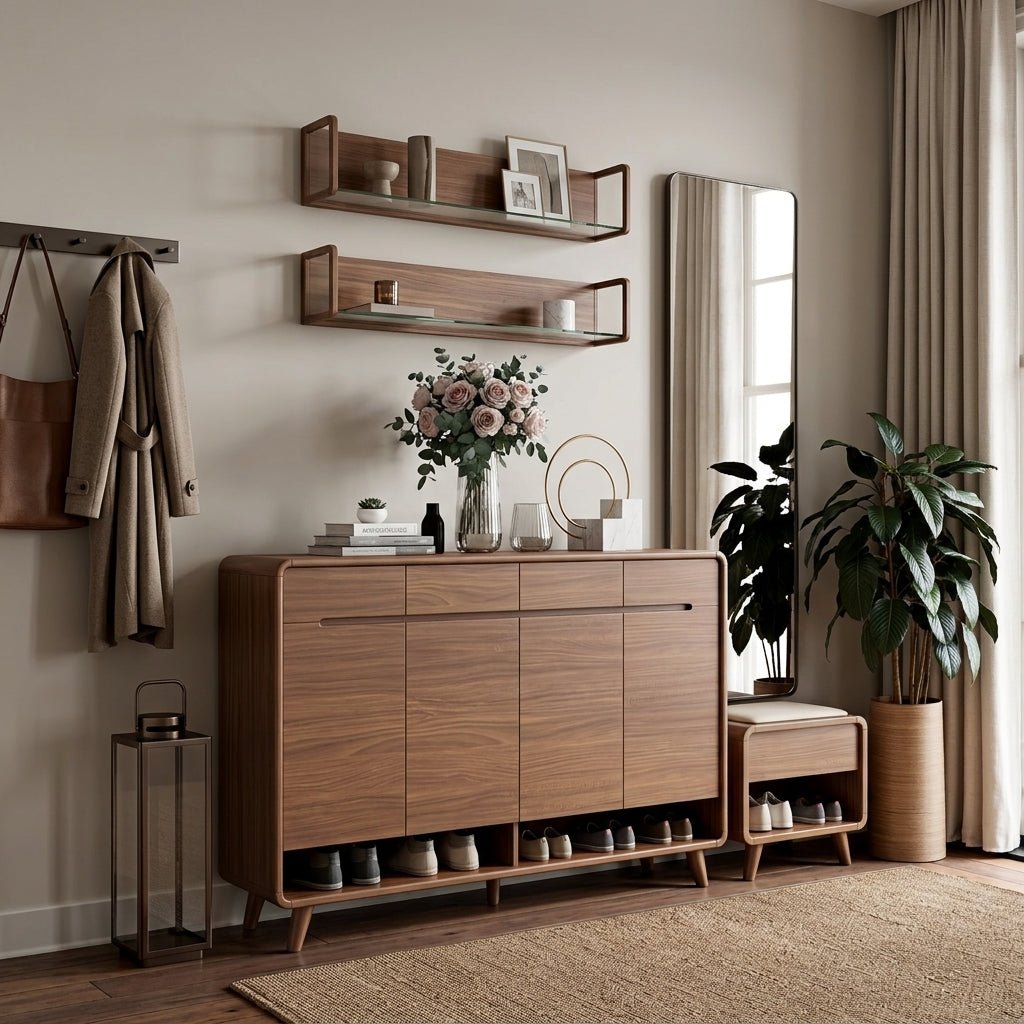
Natural wood brown finish with three tilt-out shoe drawers and one utility shelf. Measures 80 cm wide and 120 cm tall. Fits hallways that cannot accommodate a wider piece.
View CabinetMaterial and Finish: Connecting the Entryway to the Rest of the Home
The entryway is the transition point between the outside world and your interior design. The cabinet you choose here sets a visual expectation for the rooms beyond it. Its material and finish should echo the dominant tones of adjacent spaces, not necessarily match them exactly.
Natural Wood
If your home leans toward warm Scandinavian or mid-century modern design, a natural wood shoe cabinet creates a natural transition. The SC54 Shoe Cabinet has clean lines that feel modern without being cold, and its natural brown finish warms up even the most neutral hallway. For larger families or those who want modular sizing options, the SC01 Shoe Cabinet offers the same warmth in a walnut finish across five width configurations.
SC54 Natural Wood · $890
SC01 Walnut Finish · From $390
White and Light Finishes
In darker or narrower entryways, a white cabinet reflects light and makes the space feel larger. White is also the most versatile finish, working with every interior style from minimalist to coastal to traditional. The SC52 White Shoe Cabinet is well suited to condos and apartments where lightness and clean lines are the priority. Available in three widths from 80 to 120 cm.

White melamine finish with natural wood accents. Angled interior shelves keep shoes organised behind closed doors. Available in 80, 100, or 120 cm widths.
View CabinetCeramic and Premium Surfaces
For entryways that serve as a design statement, a ceramic-topped shoe cabinet combines durability with visual refinement. Ceramic resists scratches, stains, and moisture better than wood, a practical advantage in a space that endures daily contact with keys, bags, and wet items. The SC35 Ceramic Top Shoe Cabinet is 220 cm long and 40 cm tall, making it a low, horizontal piece that reads more like a console than a storage unit.

Scratch-resistant ceramic surface on an MDF wood body. At 220 cm long and 40 cm tall, it sits low like a console table, keeping the entryway feeling open rather than enclosed.
View CabinetLighting: Small Space, Big Return
Most entryways rely on a single overhead fixture, usually whatever the builder installed. This creates flat, even light that makes the space feel like a corridor rather than a room. One or two intentional lighting choices change that completely.
A wall sconce at eye level is the most effective upgrade. It casts light upward and downward, creating depth on the walls without taking up floor space. If your ceiling is high enough, a small pendant provides a focal point that signals intention: this is a designed space, not an afterthought.
A floor lamp positioned just inside the entryway, beside or just past the shoe cabinet, creates a pool of warm light that greets you when you open the door. This matters especially during Canadian winters, when you arrive home after dark for months at a stretch. The Helsinki Glow, at 148 cm tall with an omnidirectional diffused glow, is well suited to narrow hallways: its vertical silhouette takes up almost no floor footprint while casting warmth across the whole space.

A 148 cm floor lamp with a sinuous vertical silhouette and soft omnidirectional light. Slim enough for narrow hallways. Brushed aluminium and iron construction.
View LightStyling the Top Surface
The top of your shoe cabinet is the visual centrepiece of the entryway. It is the first surface your eye lands on when you walk through the door. Keep it considered, not cluttered: one functional item, one decorative item, one organic element.
The Functional Layer
A ceramic tray or shallow dish for keys and loose change prevents the daily scatter and signals that this surface is maintained. Choose a tray that works with the cabinet finish: a brass tray on dark wood, a matte white dish on a white cabinet, a stone tray on a ceramic surface. The contrast between materials is what makes the arrangement look deliberate.
The Decorative Layer
A framed print leaned against the wall (rather than hung, because leaning looks considered rather than permanent), a sculptural object, or a small stack of books creates visual interest at the moment of entry. Keep the scale proportionate to the cabinet. Oversized art in a narrow hallway reads as crowded, not bold.
The Organic Layer
A single stem in a bud vase, a small potted plant, or a branch of dried eucalyptus brings the arrangement to life. This is the element that changes with the seasons, and it does more work than its size suggests. In Canadian homes where winters are long and grey, a piece of greenery in the entryway provides a small but genuine lift every time you walk through the door. Choose something low-maintenance: pothos and snake plants both survive in the low-light conditions most hallways provide.
Styling Rule
The Edit Test
Once you have styled the top of your cabinet, remove one item. If the arrangement still looks right, the edit was correct. If it feels empty, add it back. The goal is intention, not decoration. Everything on the surface should earn its place, not just occupy it.
Making the Most of a Narrow Hallway
Canadian condos and townhouses often have entryways barely four feet wide. In these spaces, every centimetre matters. The most effective strategy is simple: keep one wall clear for walking and use the opposite wall for all your storage and styling.
The Single-Wall Strategy
Place your shoe cabinet against the longest uninterrupted wall. Above it, install a row of hooks or a wall-mounted coat rack. This keeps jackets off the floor without requiring a closet. Above the hooks, a mirror visually doubles the width of the hallway and gives you a last-look check before you leave. The mirror is one of the highest-impact, lowest-cost upgrades in the entryway.
The Rug
A runner rug along the hallway defines the entryway as its own zone, absorbs sound, and protects the flooring from boot traffic. Choose a low-pile rug that lies completely flat. A runner that bunches under the door is a daily annoyance and a genuine tripping hazard.
Vertical Storage
When floor space is genuinely tight, go vertical. A tall, slim shoe cabinet maximises capacity within a narrow footprint while giving the wall visual weight. The SC03 Ash Wood Shoe Cabinet does this well: at 100 cm tall with solid wood doors and a fluted glass panel, it functions as both storage and a piece of furniture worth looking at.

Ash wood in walnut finish with solid wood doors and a fluted glass panel. 120 cm wide, 100 cm tall. Statement storage for entryways that can accommodate a taller piece.
View CabinetThe Entryway in Order
Styling an entryway is a sequence, not a single purchase.
Start with the shoe cabinet: choose a width that fits your hallway and a finish that connects to the adjacent rooms. Add a light source beside or just past the cabinet to create warmth the moment the door opens. Style the top surface with three items: something functional, something decorative, something alive. Install hooks or a wall-mounted rack above the cabinet for coats and bags. Add a mirror to expand the visual space and give the hallway a focal point. Finish with a flat-weave runner rug to define the zone and protect the floor.
Each layer builds on the last. The cabinet anchors the space. The light warms it. The styling makes it personal. The mirror and rug complete it. Done right, the entryway takes thirty seconds to pass through and leaves an impression that lasts.
Style Your Entryway
Shoe cabinets, lighting, and accessories for every hallway size, shipped free across Canada.
Shop Shoe Cabinets